What Does the Research Show?
-
Delayed cord clamping allows additional blood to transfer from the placenta to the newborn. This placental transfusion can increase newborn blood volume by approximately 20-30%, supporting circulation and oxygen delivery after birth. Sources: Yoon et al. (2023); Rabe et al. (2019)
-
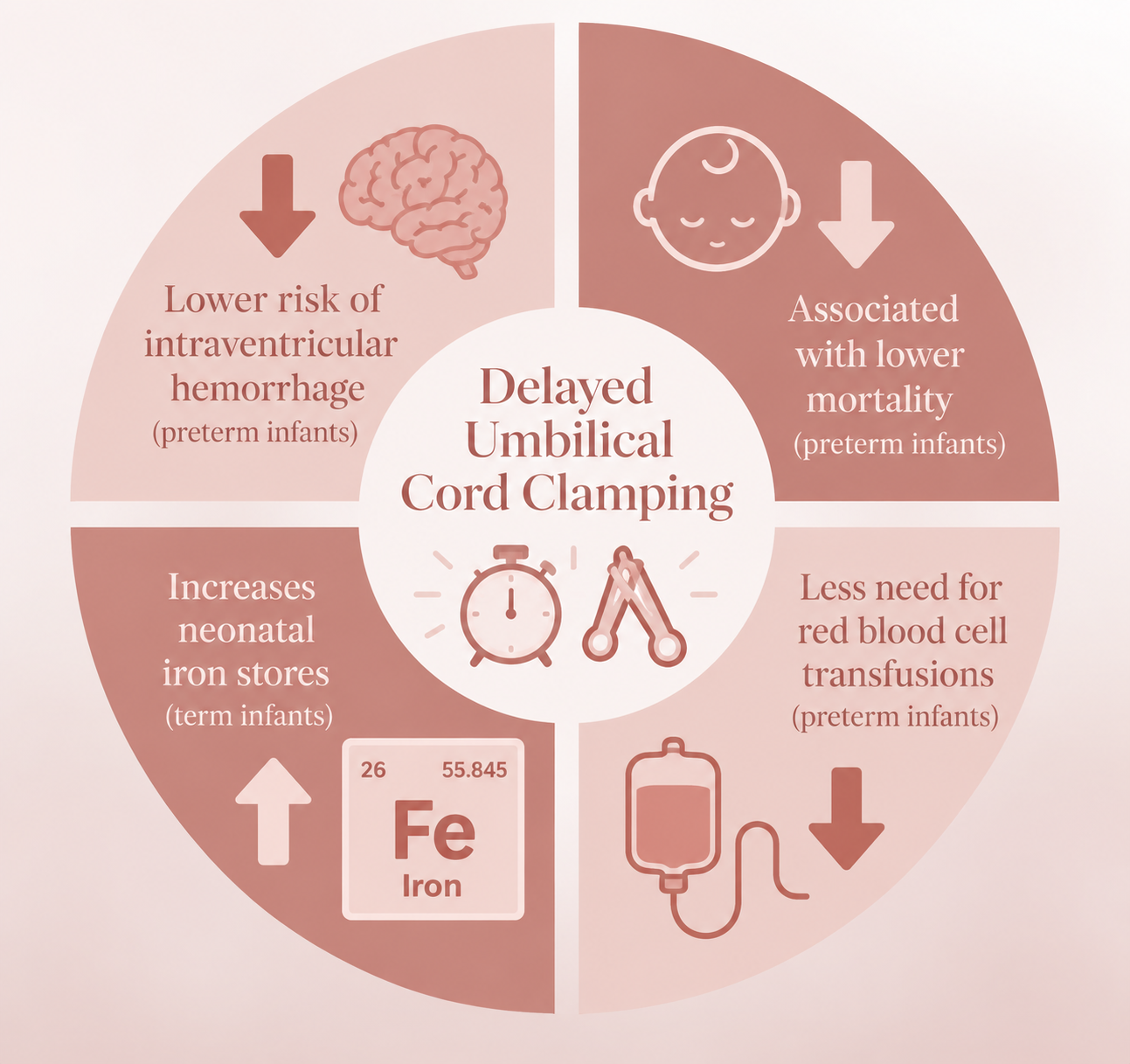
The additional red blood cells provide iron that helps build the newborn’s iron stores. Research in term infants has found higher iron stores and a lower risk of iron deficiency during early infancy after delayed cord clamping. Sources: Andersson et al. (2011); McDonald et al. (2013)
-
Delayed cord clamping supports the newborn’s transition from fetal to newborn circulation by allowing placental blood to continue flowing during the onset of breathing. However, current research has not consistently shown that it reduces respiratory complications or the need for mechanical ventilation, particularly in preterm infants. Sources: ACOG (2020); AHA & AAP (2025)
-
Delayed cord clamping is associated with a lower risk of intraventricular hemorrhage (IVH) in preterm newborns compared with immediate cord clamping. Improved blood volume and circulation may help protect vulnerable newborns during the transition after birth. Adequate iron stores are important for early brain development. Some research has reported developmental benefits, but long term neurologic outcomes are still being studied. Sources: Andersson et al. (2011); Fogarty et al. (2018).
-
Delayed cord clamping can reduce the need for red blood cell transfusions by improving early hemoglobin levels and increasing red blood cell volume. Reduced transfusion needs are an important finding in preterm infants, particularly those born before 32 weeks, but is not an established benefit for vigorous newborns. Source: ACOG (2020)
-
Delayed cord clamping is associated with improved survival in preterm newborns. A systematic review and meta-analysis by Seidler et al. (2023), which included 6,367 preterm infants across 48 randomized trials, found that delayed cord clamping reduced the odds of death before hospital discharge compared with immediate clamping. These findings support delayed cord clamping as an important evidence-based practice for improving outcomes in preterm infants.
Source: Seidler et al. (2023)
-
Delayed cord clamping may slightly increase the likelihood of jaundice, but research suggests it does not significantly increase the need for phototherapy. Newborn jaundice and bilirubin should be monitored as a part of routine care and current clinical guidelines. Sources: McDonald et al. (2013); ACOG (2020)
Research supports delayed cord clamping for many term and preterm newborns, with benefits varying by gestational age. Clinical decisions should follow current guidelines and prioritize maternal and newborn stability.

20-30%
Approximate Increase
Increase in newborn blood volume
A randomized controlled trial involving 73 term infants compared delayed cord clamping of 5 minutes with immediate cord clamping of 20 seconds. The study found a general increase newborn blood volume by approximately 20–30%.
18.6%
Relative Reduction
Fewer preterm infants need RBC transfusions
In a systematic review of 56 studies involving 6,852 preterm infants, transfusions were needed in 38.2% of infants with DCC vs. 46.9% with immediate clamping. This represents an 8.6 percentage point difference.
2.6%
Absolute Difference
Lower hospitality mortality among preterm infants
In the same review, hospital mortality was 5.0% with DCC compared to 7.6% with immediate clamping.
45%
Higher Mean
Improved iron stores in term infants
A randomized trial of 400 full term infants found that DCC was associated with 45%higher mean ferritin at four months and iron deficiency in 0.6% of infants versus 5.7% with early clamping